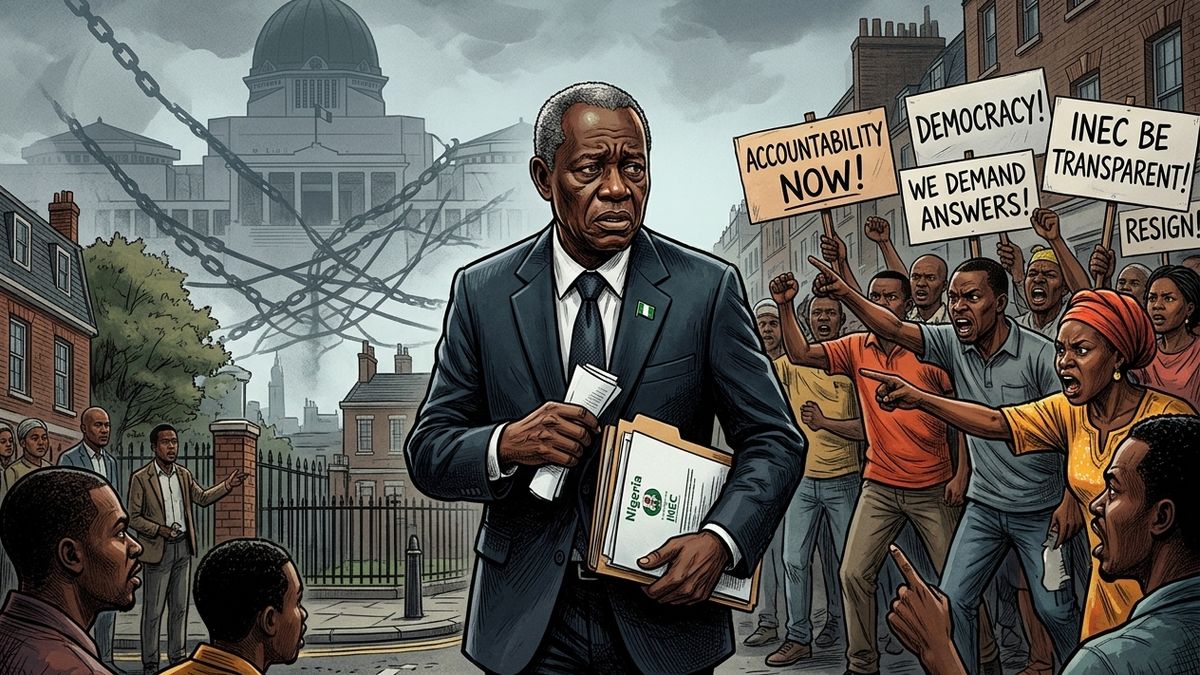
There is something increasingly troubling about the relationship between Nigerian citizens and those who accept public appointments to serve the country. Beyond legitimate criticism of government policies and institutional failures, we appear to be witnessing a growing culture of personal hostility towards individuals who accept public responsibilities.
The recent incident involving the Chairman of the Independent National Electoral Commission (INEC), Professor Joash Amupitan, outside Chatham House in London brings this concern into sharp focus.
During his visit to discuss Nigeria's electoral preparedness ahead of the 2027 general elections, a group of Nigerians confronted him, demanding his resignation and questioning the credibility of the commission. Their grievances reportedly included concerns about irregularities in the preliminary voters' register, including questionable registrations and suspected manipulated photographs.
These are legitimate issues deserving investigation and transparent answers. INEC has acknowledged problems with its registration records, announcing the removal of more than 1.6 million invalid registrations and 873 records belonging to deceased persons.
Citizens have democratic right to demand accountability. Electoral credibility is fundamental to democracy, and INEC must answer difficult questions.
However, the manner in which public officials are confronted, surrounded, intimidated or subjected to personal humiliation raises a broader question: What happens to a country when its most capable citizens begin to see public service as a personal liability rather than an opportunity to contribute to national development?
This question becomes even more important against the background of political violence, threats and intimidation increasingly associated with political participation in Nigeria.
The burden of public service
Commenting on the incident, Dr Reuben Abati of Arise TV referenced Mohammed Bello Adoke SAN's book, Burden of Service: Reminiscences of Nigeria's Former Attorney-General, to highlight the pressures associated with occupying public office.
In Nigeria, accepting a public appointment often means inheriting not just the responsibilities of an office but also the accumulated frustrations and disappointments citizens have towards government.
An individual who has spent decades building a professional reputation as an academic, economist, lawyer, engineer or business leader may suddenly find that reputation subjected to intense public scrutiny simply because he or she accepted an appointment.
Sometimes, the criticism is justified. Public officials must explain their decisions and face the consequences of misconduct. But there is a difference between accountability and personal intimidation.
A minister may become the face of an unpopular government policy. An agency head may be blamed for institutional failures that predate his appointment. An electoral commissioner may become the target of political anger arising from electoral outcomes.
Public office does not confer immunity from criticism, but neither does it strip individuals of their right to personal dignity and security.
When political competition becomes dangerous
There is another dimension to this problem that deserves greater attention: political violence.
Nigeria's political environment has long been characterised by electoral intimidation, attacks on political gatherings, threats against candidates, politically motivated killings and allegations of the recruitment and financing of armed groups by political interests.
Violence also occurs within political parties, particularly during disputes over nominations, party leadership and control of political structures.
The consequences extend beyond the immediate victims. Where political intimidation becomes normalised and those responsible are not effectively investigated and prosecuted, the entire democratic environment suffers.
Professionals contemplating elective office must consider whether they are prepared to expose themselves and their families to threats, physical attacks, kidnapping and reputational damage.
An accomplished entrepreneur aspiring to become governor, a respected academic considering a legislative seat or a professional invited into government may reasonably question whether the political environment offers sufficient protection for personal safety and professional independence.
Alexander Thurston's 2018 article, The Politics of Technocracy in Fourth Republic Nigeria, published in the African Studies Review, provides a useful framework for understanding this dilemma. His research examines how technocrats entering government become entangled in political interests and public controversies, despite their professional reputations.
The problem is that expertise alone does not protect individuals from political hostility.
Are we driving competent people away?
This is perhaps the most serious long-term consequence.
Nigeria has a large pool of accomplished professionals in medicine, engineering, finance, law, technology, academia, business and public administration. Many have spent decades developing expertise that could contribute significantly to national development.
Yet entering politics can involve substantial financial costs, political godfatherism, pressure to compromise personal principles, intimidation and the potential disruption of established careers.
For those accepting appointive positions, the risks include political interference, arbitrary removal, pressure to compromise professional standards and personal attacks arising from government decisions.
A professional who leaves a successful private-sector career to serve in government may sacrifice income, independence and personal time. If the additional price is personal insecurity and sustained hostility, some may reasonably conclude that the sacrifice is not worthwhile.
This is not to suggest that professional qualifications automatically translate into good political leadership nor can we assume that political hostility is the principal reason competent Nigerians avoid public service. That requires empirical research.
When competent and independent-minded people withdraw from public service, the political space does not remain empty. It is occupied by others. If financial resources, political connections and patronage become more important than competence, Nigeria risks narrowing the pool of people capable of contributing to leadership.
This would be a significant loss to national development.
Accountability is not intimidation
Nothing in this argument should suggest that public officials deserve immunity from criticism.
A minister who fails to deliver should be questioned. A governor who mismanages public resources should be investigated. An INEC chairman must provide convincing explanations about the electoral register, electronic transmission of results and the independence of the commission.
Citizens have legitimate democratic instruments for challenging poor governance: peaceful demonstrations, petitions, court actions, media engagement, legislative investigations and the ballot.
Sections 39 and 40 of the Nigerian Constitution protect freedom of expression, association and peaceful assembly.
Equally, these rights do not grant anyone permission to assault, threaten or unlawfully intimidate another person.
We must also distinguish peaceful protest from political violence. The state must not use the protection of public officials as an excuse to suppress dissent. Equally, political dissatisfaction cannot justify assassination, kidnapping, armed intimidation or attacks on candidates and their supporters.
The right to demand accountability does not include the right to intimidate. The right to hold public office does not include the privilege of escaping scrutiny.
What should Nigeria do?
Nigeria needs a framework that protects democratic participation without shielding public officials from accountability.
First, the police and relevant security institutions should establish clear protocols for protecting public officials and political aspirants against credible threats, irrespective of party affiliation.
Second, politically motivated attacks must be investigated and prosecuted. This should include identifying those who finance, organise or protect violent groups, where evidence establishes their involvement. Those who pull the triggers should not be the only people held accountable.
Third, political parties must strengthen internal democracy, make nomination processes more transparent and address financial barriers that exclude capable aspirants.
Fourth, independent-minded public officials should enjoy institutional protection against arbitrary removal and retaliation for refusing unlawful instructions.
Finally, government, political parties, the media, civil society and religious institutions must promote a political culture that accommodates disagreement without normalising intimidation or violence.
The experiences of the United Kingdom, France and Germany demonstrate that protecting public officials against threats can coexist with protecting citizens' democratic rights. Nigeria can develop similar safeguards suited to its own circumstances.
Let us not discourage those who want to serve
There is a fundamental difference between criticising someone for how they have performed in public office and making the acceptance of public responsibility an invitation to personal hostility.
We need more competent Nigerians in public service, not fewer. We need professionals willing to contribute their knowledge and experience to strengthening national institutions. We need citizens courageous enough to challenge poor leadership, but responsible enough to respect the rights and dignity of others.
We also need political leaders who understand that public office is a responsibility, not a licence for impunity.
Ultimately, Nigeria must address both the abuse of public office and the abuse of citizens' democratic rights.
We must insist on accountability without intimidation, political competition without violence and public service without victimisation.
A country cannot afford to create an environment in which the people most capable of serving it begin to consider public service a punishment rather than a privilege.
Because when the willingness of competent citizens to serve begins to disappear, the loss is not merely theirs.
It is a loss to Nigeria. And ultimately, it is the Nigerian people who will bear the cost.
November 2026
Lagos