I learned a hard lesson from my son.
He is 15 years old and lives with cerebral palsy, the result of complications and poor medical handling at birth. While his condition affects his speech and movement, it has never diminished the depth of his emotions, his quick intelligence, or his boundless capacity to love.
In our search for a more independent and fulfilling life for him, my wife, our son, and his sister relocated abroad. The physical separation has been a heavy burden on our family, making every visit a precious time of joy.
During my trips, my children barely leave my side. My son, especially, wants to share every moment with me, rushing home from school the instant the bell rings. For those few days, my wife gets a much-deserved break while the children get their father all to themselves.
The Words We Leave Behind
But every visit has an end.
When departure day approaches, the energy shifts. The laughter fades, the house grows quiet, and the airport trip always ends in tears.
On one particular trip, as we got to the airport, my wife, my daughter, and my son were all crying. I called my son aside, intending to give him courage.
"Son," I said, "you're a young man. You shouldn't be crying like your sister and your mum. Wipe your tears and remember that you are the man of the house while I'm away. Take care of the ladies, okay?"
He looked at me with profound confusion, his face clouded with uncertainty. But being an obedient son, he swallowed his sobs, wiped his eyes, and held it inside. I didn't think much of it at the time.
An Unexpected Distance
To soften the emotional impact of leaving, my routine was to tell him a few days in advance when I was departing so he could process it. On my next visit, as the trip was ending, I brought it up as usual.
"Son, I'll be leaving next week. We'll all go to the airport together." Since it was a weekday, I added that he would miss school that day.
To my surprise, he declined. He said he wasn't going to the airport; he preferred to go to school.
I assumed something special was happening at school and figured he would change his mind when departure day arrived. But the night before I left, when I mentioned the trip again, he firmly refused. Despite our efforts to persuade him, he chose his routine school day over our final goodbye.
I was puzzled, but I brushed it off.
Months later, on another visit, the exact same thing happened. This time, it was a weekend.
"So, if you don't come to the airport, you'll stay home alone?" I asked.
"Yes," he replied.
I was stunned. My son loves me deeply. He cherishes every second we have together, so why was he willingly giving up our final hours? Why choose to sit home alone rather than ride to the airport with me?
The Message on the Screen
On the eve of my departure, I tried once more: "We're going to the airport tomorrow."
"No," he repeated. "I'll stay home."
Sensing something deeper, I gently pushed: "Hey, son, what's really going on?"
He began trying to explain, his voice rising with frustration. He was becoming increasingly agitated, desperate to communicate something I couldn't decode. I called his sister, the person who understands his speech best, but even she couldn't interpret what he was trying to say.
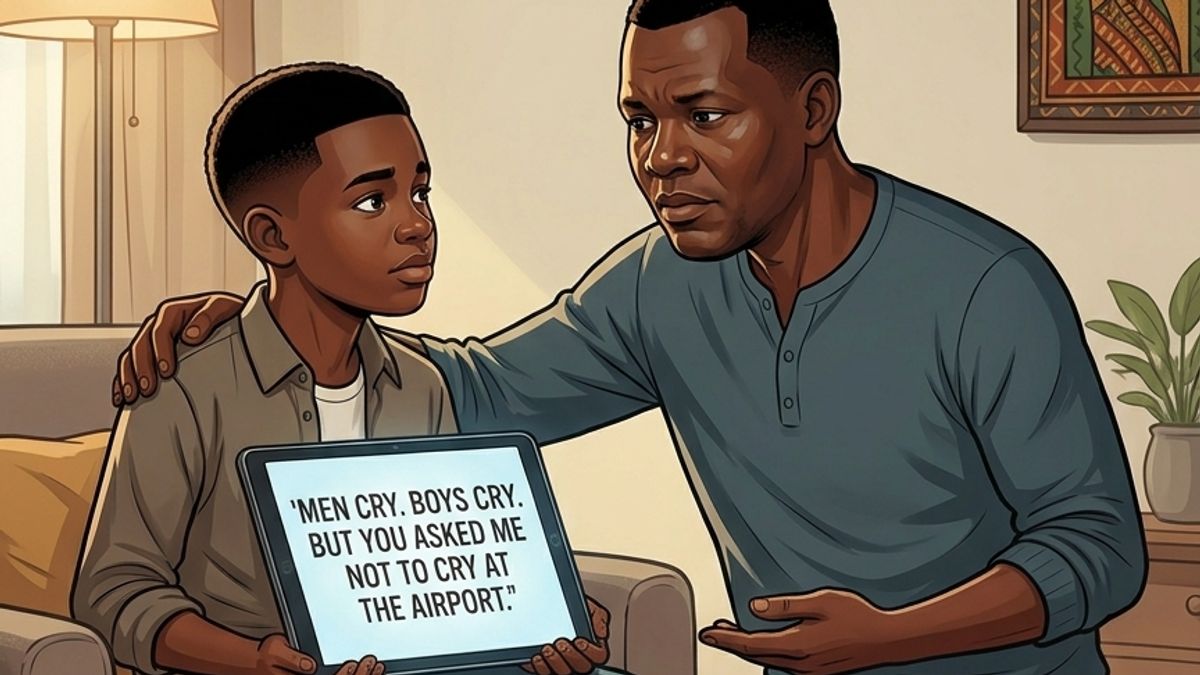
Then, my son did something he rarely does at home. He went to his room and brought out his iPad, the assistive communication device he usually avoids in favor of gestures and direct speech.
He needed to be 100% sure I understood.
He typed slowly, deliberately, and then turned the screen to face me.
On it were just a few words:
"Men cry. Boys cry. But you asked me not to cry at the airport."
What True Strength Means
The realization hit me like a physical blow.
Everything became crystal clear. His refusal to go to the airport was never about missing school or lacking affection. He was protecting himself from a situation where he felt forced to suppress his natural grief.
In my effort to teach him responsibility, I had accidentally taught him that his genuine tears were something to hide or be ashamed of. And because he loved me so much, he knew he wouldn't be able to hold back his tears at the airport, so he chose to stay behind.
I pulled him into a long, tight hug, my own eyes welling up.
"I'm so sorry, son," I whispered. "Please come to the airport. You can cry if you want to. You can cry as much as you need."
That moment reshaped my understanding of fatherhood and masculinity.
Being a man does not mean locking away your emotions. Strength is not the absence of tears, and courage isn't pretending that saying goodbye doesn't break your heart. Carrying responsibility for your family should never mean suffering in silence while everyone else is allowed to feel.
We often give children instructions trying to make them strong, only to realize we've taught them to hide the very feelings that make them human.
I set out to teach my son how to be a man. Instead, he taught me what being a man truly means.
September 2026
Lagos