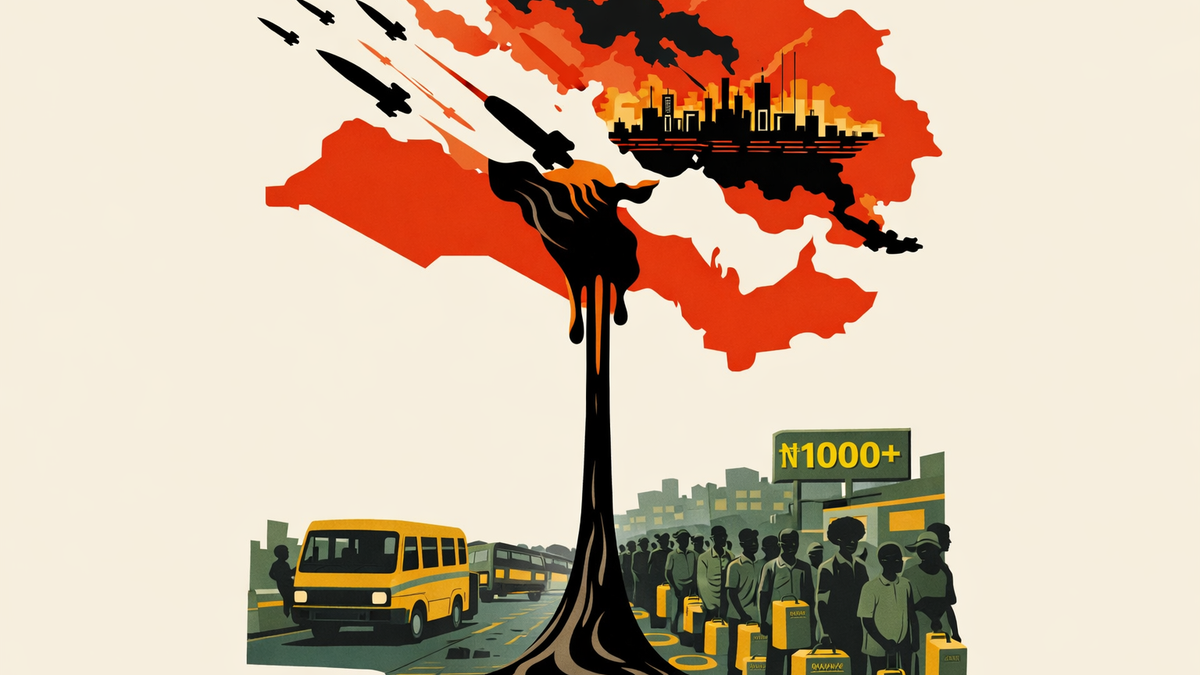
On 28 February 2026, coordinated air strikes by the United States and Israel hit key targets in Iran, igniting a conflict that quickly dominated global headlines. Images of burning facilities in Tehran and intercepted missiles over Tel Aviv spread rapidly, alongside reports of the assassination of Supreme Leader Ali Khamenei.
For many Nigerians, the war initially felt distant—another geopolitical crisis unfolding far away. Within days, however, its effects became unmistakably local, not through violence but through a familiar pressure point: the cost of fuel.
From the Twelve-Day War to Operation Epic Fury
The 2026 war did not emerge in isolation. It built on tensions from the 2025 Twelve-Day War between Israel and Iran, a conflict that, while intense, remained limited and diplomatically contained.
This time was different. The February strikes marked a dramatic escalation, shifting from targeting infrastructure to eliminating leadership. The killing of Khamenei signalled a break from previous norms and removed any immediate path to de-escalation, pushing the region into a prolonged and unpredictable confrontation.
The Strait of Hormuz and the Global Oil Shock
At the centre of the economic fallout is the Strait of Hormuz, one of the world’s most critical oil corridors. Roughly a fifth of global oil supply passes through this narrow route each day.
Iran’s retaliation, including attacks on shipping lanes and threats of closure, triggered a sharp supply disruption. Within days, global oil prices surged, with Brent crude rising from about $70 to over $110 per barrel.
This shock rippled across energy markets. Major producers in the Gulf scaled back exports amid logistical constraints, and analysts warned that prolonged disruption could push prices even higher and intensify inflation worldwide.
Nigeria’s Oil Paradox: Why Higher Prices Still Hurt at Home
For Nigeria, the current crisis presents a striking contradiction. As a major oil producer, higher global crude prices should boost government revenues. With oil trading well above the 2026 budget benchmark of $64.85 per barrel, earnings per barrel have increased significantly, offering potential relief for fiscal deficits and public finances.
Yet this apparent advantage has brought little comfort to ordinary Nigerians. Instead, rising global prices are translating directly into higher living costs, driven largely by fuel.
A key reason lies in structural dependence. Despite the emergence of the Dangote Petroleum Refinery, Nigeria’s downstream sector remains closely tied to international market dynamics because a substantial share of its crude feedstock is still priced globally. As a result, domestic fuel prices continue to mirror global trends.
By mid-March 2026, petrol prices in major cities had exceeded ₦1,000 per litre. With daily consumption estimated at roughly 80 million litres, the effects are widespread. Transport fares rise, food becomes more expensive, and businesses face higher operating costs. These pressures combine to drive inflation, steadily eroding household purchasing power across the country.
How the Shock Spreads Through the Economy
The impact of rising fuel prices extends far beyond the cost of transport, filtering through nearly every layer of the economy. As distribution becomes more expensive, food prices inevitably rise, placing additional strain on household budgets. Electricity costs also increase, particularly in a system that still relies heavily on fuel-powered generation. At the same time, pressure mounts on the naira as demand for foreign exchange grows, further complicating the economic outlook.
Businesses are forced into difficult choices. Some absorb the higher costs, reducing already thin margins, while others pass them on to consumers through higher prices, reinforcing inflationary pressures across the economy. In response to these mounting challenges, labour groups such as the Nigeria Labour Congress have called for wage adjustments and targeted relief measures to help workers cope with the rising cost of living.
What Nigeria Can Do
Short-Term Relief
Immediate interventions are necessary to ease the burden on households:
- Targeted cash transfers to vulnerable populations using excess oil revenue
- Expanded naira-for-crude arrangements to reduce exposure to global price swings
- Temporary suspension of import duties on essential food items to curb inflation
- These measures can provide rapid, though temporary, relief.
Medium-Term Reforms
To reduce vulnerability, Nigeria must address structural weaknesses:
- Scale up domestic refining, including rehabilitating state-owned refineries
- Increase oil production by tackling theft and pipeline vandalism
- Manage windfall revenues prudently by directing them towards infrastructure and fiscal buffers
Long-Term Strategy
Ultimately, the solution lies in reducing dependence on oil:
- Diversify the economy into agriculture, manufacturing, and services
- Invest in renewable energy to lower reliance on imported fuels
- Strengthen local supply chains to insulate against global disruptions
Conclusion: A Distant War, a Domestic Crisis
The 2026 Iran conflict illustrates how deeply interconnected the global economy has become. A war thousands of kilometres away has translated into higher fuel prices, rising inflation, and tighter household budgets in Nigeria.
While the government may benefit from increased oil revenues, ordinary citizens bear the immediate cost. Bridging this gap requires deliberate policy choices that provide short-term relief while building long-term resilience.
Without such action, external shocks will continue to turn foreign crises into domestic hardship.