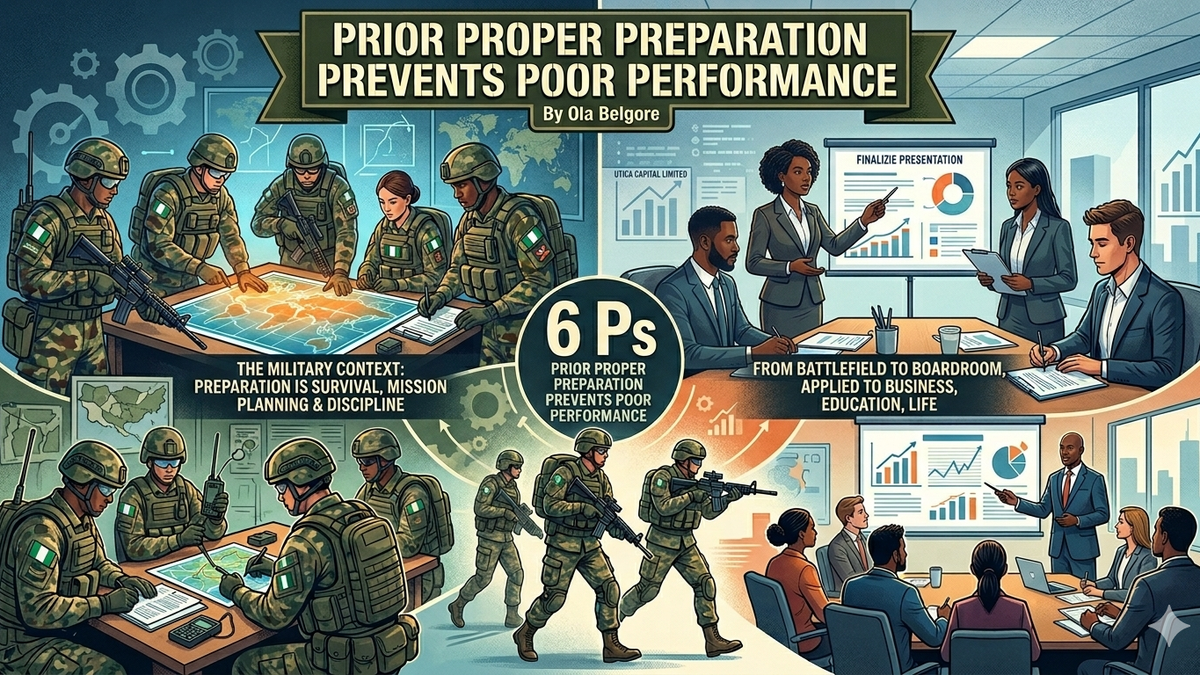
“Prior Proper Preparation Prevents Poor Performance,” often called the 6 Ps, is a phrase deeply rooted in military culture. Though widely associated with the British Army and echoed throughout forces such as the United States Army, its underlying philosophy transcends borders and branches.
At its core, the saying reflects a hard-earned battlefield truth: success under pressure is never accidental; it is prepared for.
The Military Context: Why Preparation Is Survival
In civilian life, poor preparation might mean embarrassment, lost money, or missed opportunities. In military operations, it can mean mission failure or loss of life.
Combat environments are defined by uncertainty. Intelligence is often incomplete. Conditions change rapidly and without warning. Equipment can fail at the worst possible moment. Human beings grow tired, hungry, and stressed. Chaos is not the exception; it is the norm.
Because uncertainty cannot be eliminated, militaries focus relentlessly on what can be controlled: preparation.
Before any mission, soldiers engage in detailed briefings that clarify objectives and responsibilities. Equipment is inspected meticulously to prevent avoidable malfunction. Rehearsals simulate the mission in advance, exposing weaknesses before they become fatal. Contingency plans anticipate failure points, and communication systems are tested to ensure clarity under pressure. Every movement is considered. Every likely complication is examined. Backup plans are established long before they are needed.
The philosophy is straightforward yet powerful: the more variables you control beforehand, the fewer surprises control you later.
Training: Performing Under Pressure
One of the most enduring military lessons is this: under stress, you do not rise to the occasion; you fall to your level of training.
When adrenaline surges and cognitive bandwidth narrows, complex reasoning gives way to habit. In high-stress environments, people default to what has been practiced most consistently. For this reason, soldiers rehearse repeatedly. Drills are not about showcasing perfection; they are about embedding instinct.
Weapons are disassembled and reassembled until the motions require no conscious thought. Tactical maneuvers are practiced until communication flows automatically. Emergency procedures are repeated until reaction becomes immediate rather than deliberative.
Preparation builds confidence rooted in competence. It sharpens speed without sacrificing accuracy. It preserves clarity when emotions run high. It strengthens coordinated teamwork so that individuals operate as a unified whole.
In crisis, hesitation can be catastrophic. Preparation reduces hesitation by replacing uncertainty with familiarity.
Discipline Over Motivation
Military preparation is not sustained by bursts of inspiration. It is sustained by discipline.
Soldiers do not train only when they feel motivated. They train because readiness is non-negotiable. Equipment is cleaned whether it has been used or not. Plans are reviewed even when they appear flawless. Rehearsals continue even after previous success.
This mindset acknowledges a critical truth: complacency is the quiet enemy of performance. Success can breed overconfidence, and overconfidence erodes vigilance. Discipline counters that erosion by enforcing standards regardless of mood or circumstance.
In this framework, preparation becomes a daily habit rather than a reaction to looming pressure.
The Psychology of Preparation
Preparation is not merely logistical; it is psychological.
When individuals know they have trained thoroughly, anxiety diminishes. Fear does not vanish, but it becomes contained and directed. Confidence emerges not from blind optimism but from accumulated evidence, evidence of repetition, refinement, and readiness.
Preparation fosters resilience. It transforms uncertainty from a paralyzing threat into a challenge to be managed. The mind, fortified by practice, interprets stress differently. Instead of asking, “Can I handle this?” it recognizes, “I have handled this before.”
This psychological shift is often the hidden advantage of those who prepare diligently.
From Battlefield to Boardroom
Although born in military environments, the 6 Ps principle extends naturally into civilian life.
A business presentation mirrors a mission briefing in its demand for clarity and anticipation of questions. An exam resembles a controlled deployment into stress, where preparation determines composure. A product launch reflects operational execution, where unseen groundwork dictates visible results.
In each context, the difference between chaos and control often lies in what happened beforehand. The military does not prepare because it expects perfection; it prepares because it expects difficulty. Obstacles are assumed, not ignored. Friction is anticipated, not denied.
Preparation is not paranoia. It is respect for reality.
A Timeless Principle
“Prior Proper Preparation Prevents Poor Performance” endures because it reflects a universal human truth: pressure reveals weakness, and preparation fortifies it.
Whether on a battlefield, in a boardroom, or in the quiet challenges of everyday life, the principle remains unchanged. When the critical moment arrives, performance is not created in that instant. It is revealed.
And what it reveals was determined long before it began.